





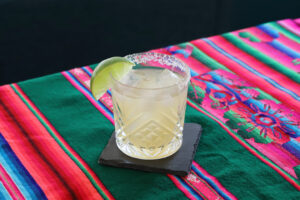
When I first mentioned the Tommy’s Margarita at home, I had to clarify to my husband – also named Tommy – that I was not referring to a margarita that I had made for him to drink. (I’m sure I did make him one shortly after.) No, the Tommy’s Margarita is a specific drink that you’ll find in Difford’s Guide and on lists of “new classic cocktails.” And I don’t think it’s hyperbole to say that the Tommy’s Margarita changed the way we all drink margaritas.
In its truest form, the classic Margarita has three ingredients: tequila, lime juice, and triple sec. It is a type of cocktail known as a daisy, a type of sour where the sweetener is a liqueur rather than a syrup. You may not have heard of daisies before, but you’ve probably had several – in addition to the Margarita, the Sidecar and Cosmopolitan are both daisies. And, wouldn’t you know, the Spanish word “margarita” means daisy!
The build of a daisy definitely favors those who like their drinks more sour, and I often add a bit of agave nectar* to my Margarita, as do many bars. I always assumed this modification was almost as old as the drink itself. Tequila is made from agave, and using an agave sweetener makes logical sense. The starting point for both tequila and agave nectar is the same – what you end up with just depends on whether you ferment and distill it or boil it down. (And what variety of agave you use, but let’s not get technical right now.) I just assumed that people in Mexico who drank a lot of tequila probably also used a lot of agave nectar.
Well, it turns out that doesn’t necessarily follow. After all, tons of maple syrup is made in Vermont and New Hampshire, but nobody is distilling maple sap into liquor. (Turns out they do in Canada, though, and if you’re interested in that you’re gonna want to read this book when it comes out.) Agave nectar was not a commonly available ingredient in the US until the 1990s, and that’s when it first found its way into a Margarita – the Tommy’s Margarita, to be exact.
*Before we launch into the tale of the Tommy’s Margarita, a quick note on agave nectar vs. agave syrup. While the amount of sugar in each can vary by brand – especially in the case of the syrup – agave nectar is generally twice as sweet as syrup. If you’ve bought both, you’ll notice that the nectar is much thicker as a result. You can make agave syrup by combining equal parts agave nectar and water.
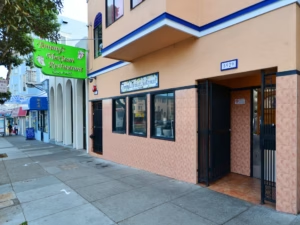
History of the Tommy’s Margarita
The “Tommy” we’re talking about is Tommy Bermejo, who opened Tommy’s Mexican Restaurant in San Francisco in 1965 with his wife Elmy. When you see this place, you would not guess that it has won multiple prestigious awards for its cocktail and tequila program. It sort of looks like… every other Mexican restaurant in San Francisco. That’s honestly part of what makes it so great.
Tommy’s is a family-run spot, and Tommy and Elmy’s children have followed in their footsteps by working at the restaurant. Their son Julio was one of the first bar managers in the US to switch to serving high-quality, 100% agave tequila and championing the category for its quality and craft as early as the 1980’s. In 1990, he tried agave nectar for the first time and decided that its flavor would compliment the good tequila better than triple sec. He started making the Margaritas at Tommy’s with agave nectar instead.
And the rest, as they say, is history. Today, even classic Margaritas often use some agave nectar, and I’ve heard more than one person in the industry say they think Tommy’s Margarita is the superior drink. But the Margarita is definitely one of those cocktails that doesn’t have a “definitive” recipe, and you should be make yours how you like. You never know; you might change the cocktail for the better.
Tommy’s Margarita
2 oz. reposado tequila (Tommy’s uses Lunazul)
1 oz. lime juice
½ oz. agave nectar
Rub a lime wedge along the edge of a rocks glass and dip it in salt. Fill the glass with ice. Combine tequila, lime juice, and agave nectar in a shaker. Add ice and shake until chilled. Strain into the prepared glass. Serve with a wedge of lime.
Additional sources found here, here, and here. Photo of Tommy’s is from The Infatuation.